François COCHARD
With the eShel III, let’s push the boundaries
The eShel III spectroscope is one of the flagship instruments in the Shelyak Instruments product line. This is the third generation of this instrument, which combines high resolution with a wide spectral range.
This instrument has two distinctive features.
First, it is an Echelle-based spectroscope that operates at very high orders. C’est ce qui lui confère sa haute résolution, malgré un nombre de traits par millimètre relativement modeste. Ces ordres sont dispersés par un prisme (appelé le disperseur croisé), orthogonalement à la direction de la première dispersion. It is this ingenious optical configuration (opticians are incredible inventors) that produces the characteristic image of an Echelle spectrograph (see Fig. X), with numerous orders that read like the lines of a book (the end of one line continues onto the next).

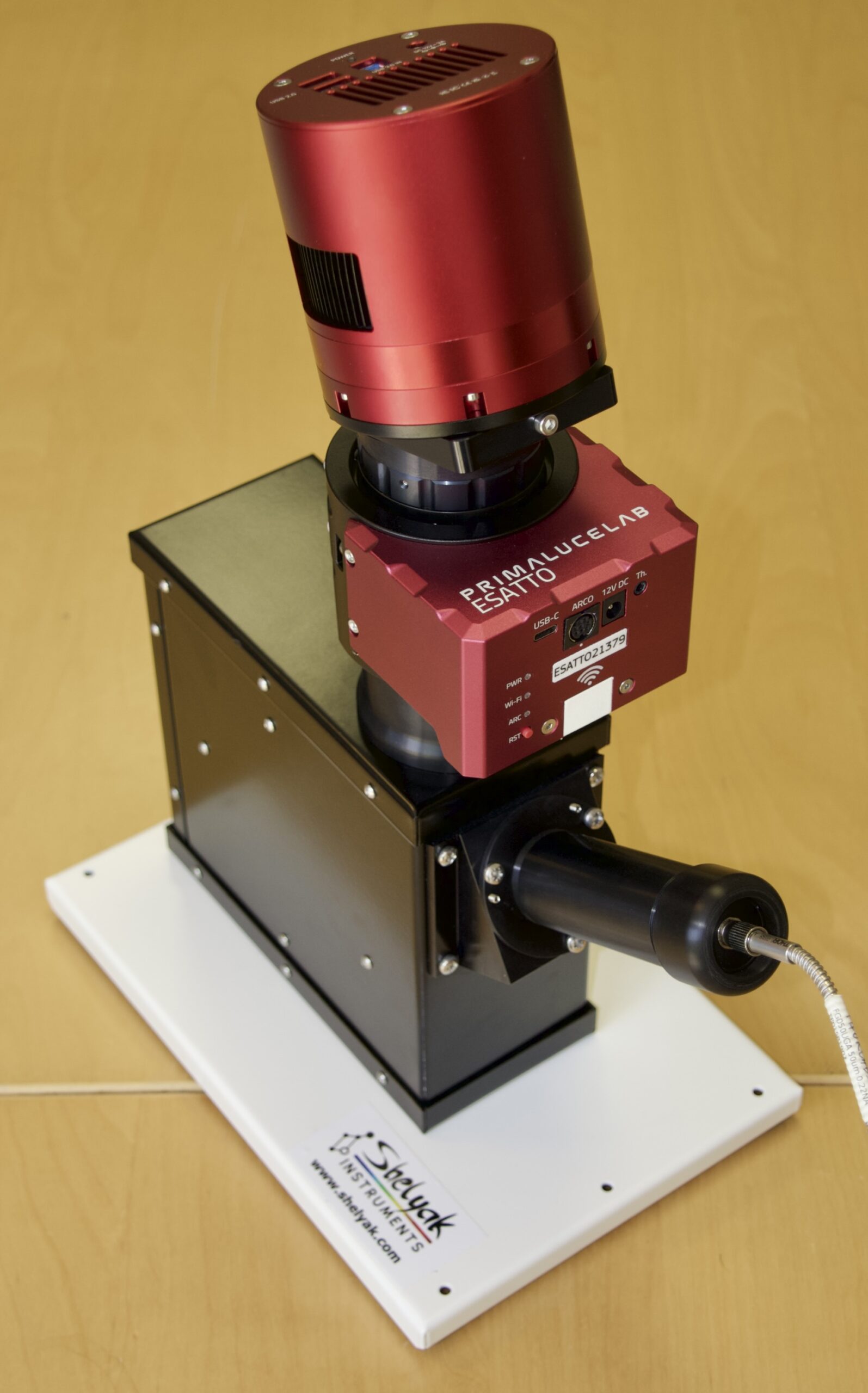
The eShel III reaches a milestone that seemed impossible just a few years ago: it incorporates a lens specifically designed for this application. This allows for significant improvements, beyond our initial expectations. The focal length is optimized to make the best possible use of the sensor selected for the eShel III (IMX571). The lens diameter is optimal for almost completely eliminating vignetting (no loss of light, even at the edges of the extreme orders). And above all, the management of chromatic aberration (as well as the anti-reflection treatment) is optimized to further expand the range of usable diffraction orders.
You have likely noticed that the eShel III camera is tilted (by approximately 15°) relative to the lens axis. This is the most visible effect of how chromatic aberration* is managed (*note: chromatic aberration is an optical defect that causes different colors to focus on different planes).
Since, in an eShel image, the red orders are on one side of the sensor and the blue orders on the other, this tilt can be used to correct for chromatic aberration. It is clearly this camera angle that makes it possible to gain several orders of magnitude in the red and blue channels.
One might think that gaining a few orders of magnitude in the red and the blue is scientifically inconsequential. In fact, it is much more significant than that: the blue and near-UV ranges are the domain of high energies (novae & supernovae, cataclysmic stars, explosions, and shocks). On the opposite,, the red and near-infrared ranges are the domain of cold matter (interstellar matter, comets, nebulae). The visible range, as we know it on Earth, is strongly linked to the Sun’s emission range. Extending observations into the blue (UV) and red (IR) ranges significantly broadens the scope for studying other objects in the universe.
Two versions: manual and motorized
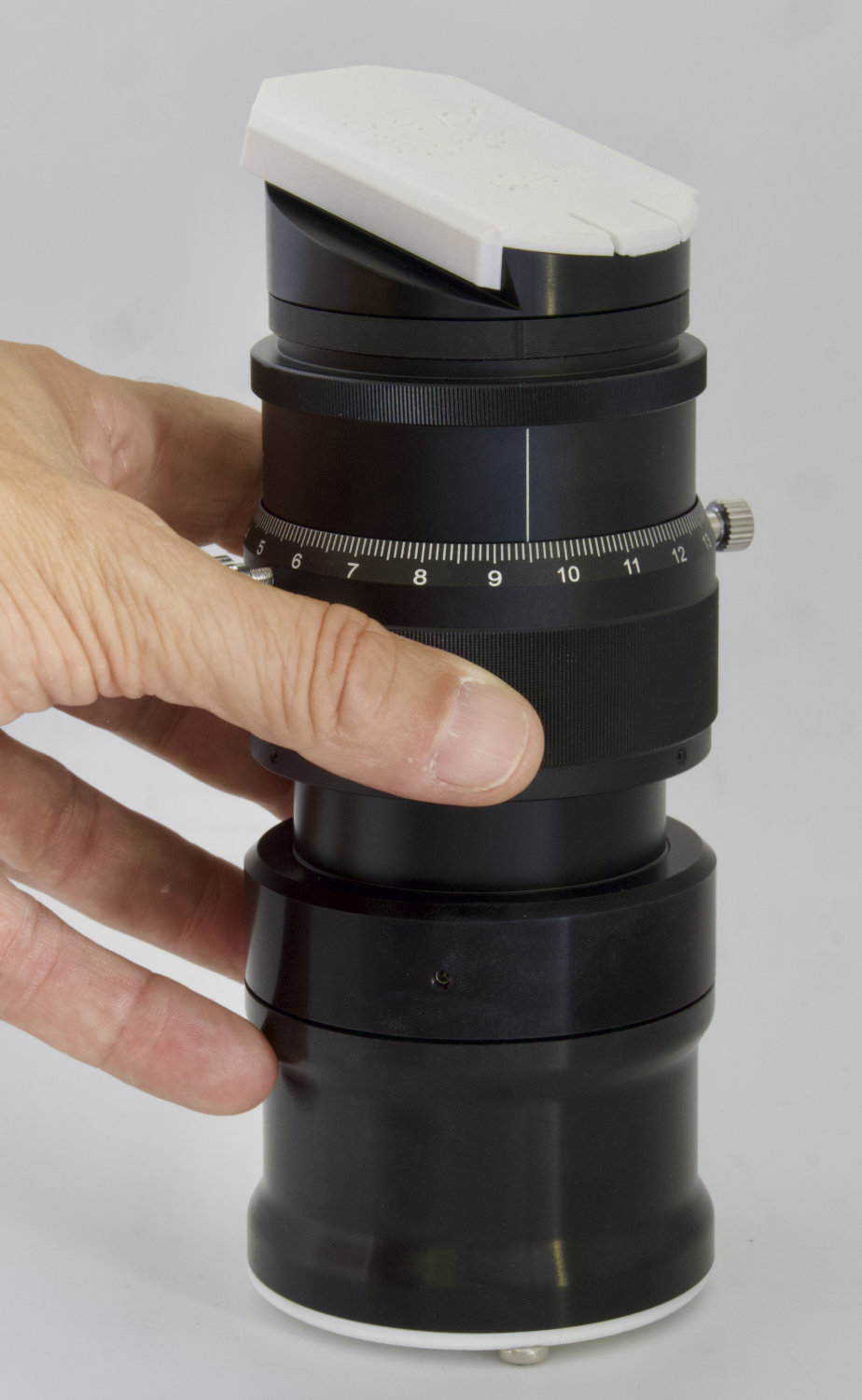
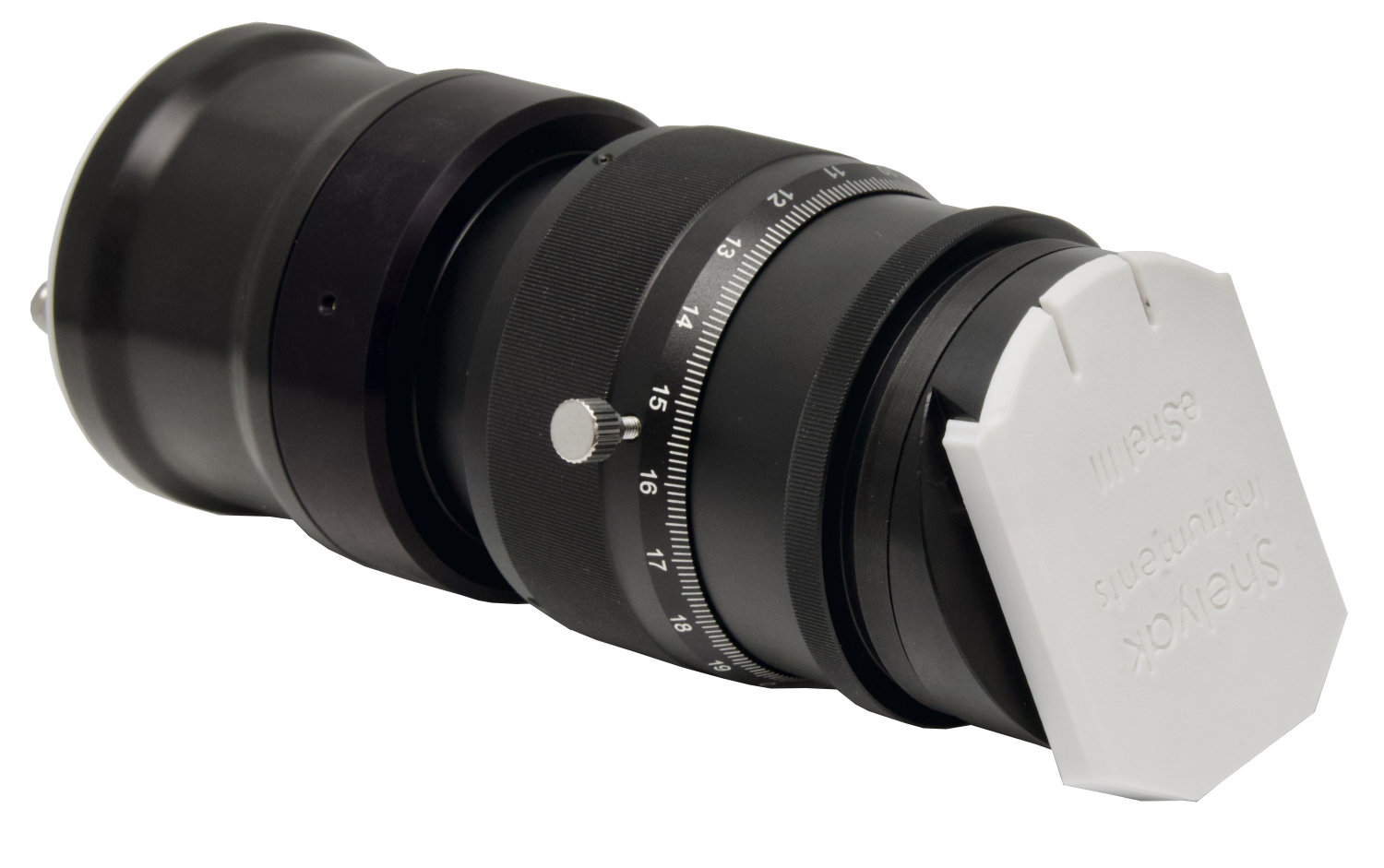
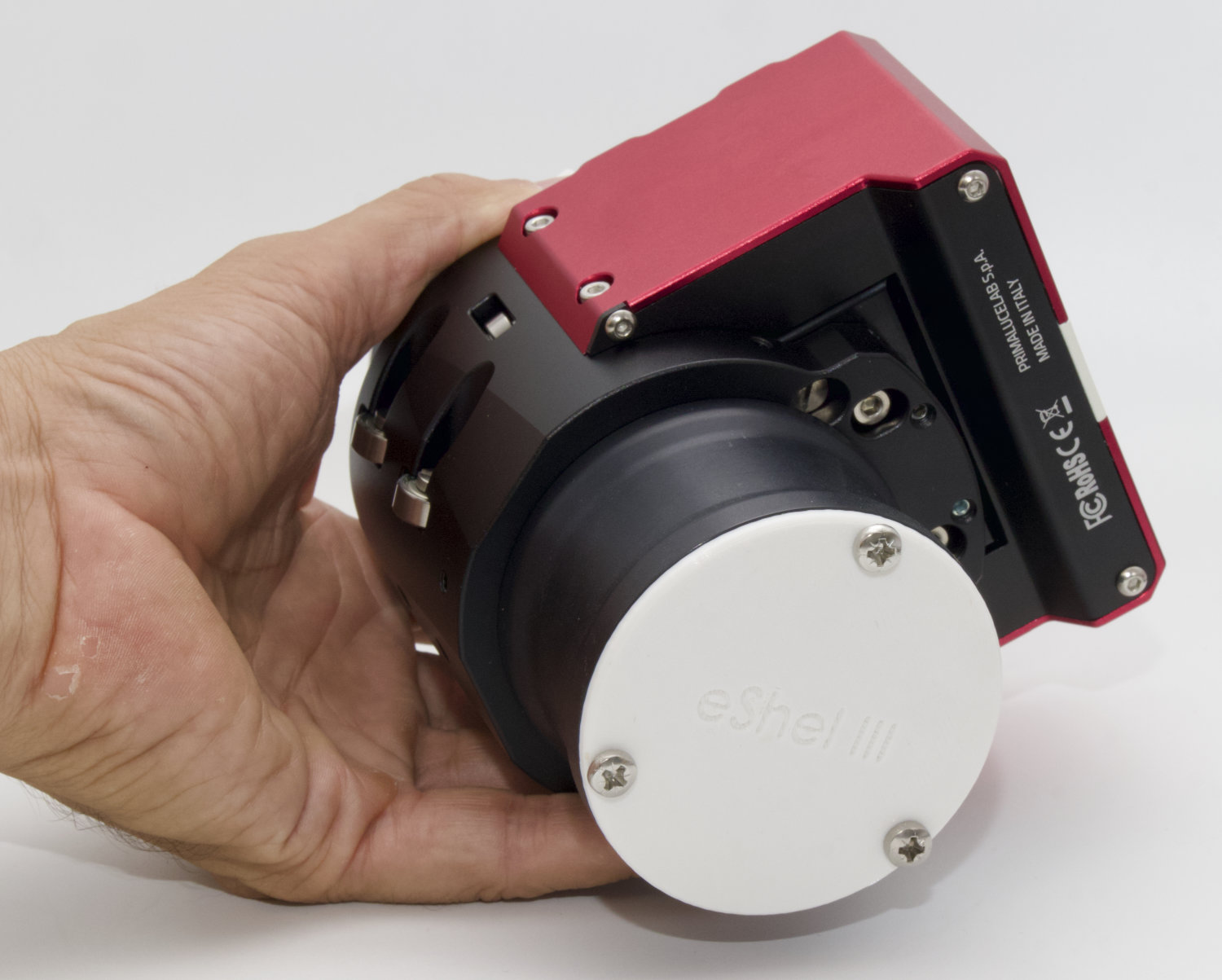
We leveraged this complete mastery of the lens to offer two mechanical versions of it. The first is manual (as the eShel II was), the second is motorized. These two versions correspond to very distinct uses.
If you are observing deside the telescope, the manual version is likely the most suitable (image on the left). Focus adjustment is performed by turning the lens ring. Simply note here that the focusing ring is noticeably smoother than the one on the eShel II; it is easier to achieve very precise focus. Naturally, this version is also the least expensive.
If you work remotely—whether a few meters from the telescope or thousands of kilometers away (an increasingly common scenario)—then the motorized version will be your preferred choice. You will then be able to perform fine-tuning via your computer. We opted for a PrimaLuceLab focuser, which is not only highly precise but can also be controlled in a variety of ways (USB, Wi-Fi, Ethernet, ASCOM, or INDI, etc.).


Upgrading from eShel II to eShel III
The announcement of the eShel III is accompanied by a new version of Demetra (version 9), designed to accommodate extreme orders. With this version of Demetra, you will be able to process orders 27 through 59, covering a wavelength range from 379 to 853 nm.
Clearly, eShel III images provide a few additional usable orders (let’s say from 22 to 62, i.e., 360 to 1,000 nm). However, the wavelength calibration method used by Demetra (which relies on a thorium lamp) reveals its limitations here: there are no longer enough thorium lines present in these extreme orders! We have a few ideas to explore for bypassing these limitations and further expanding the capabilities of the eShel III, but it will take some time.

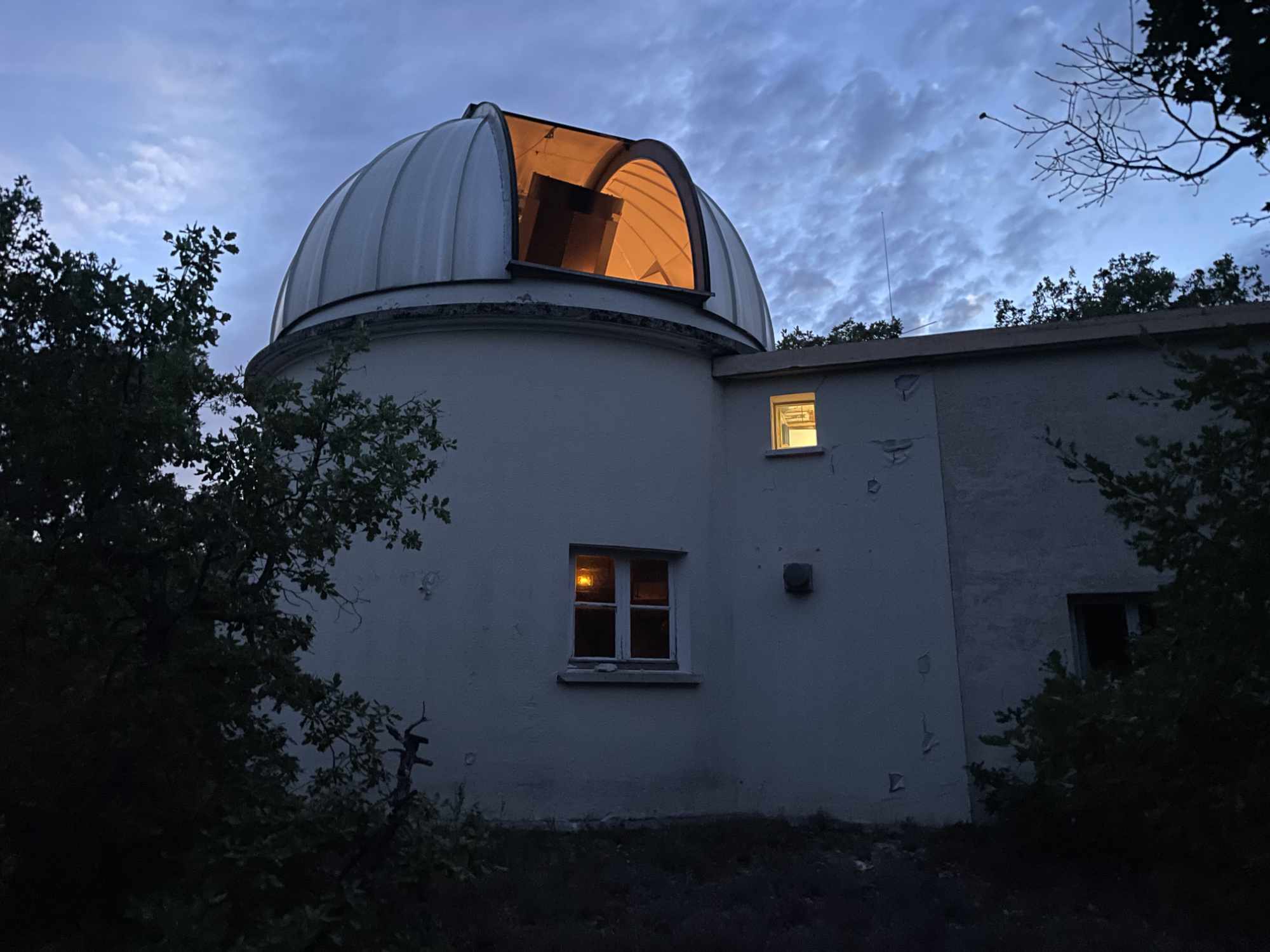
It is a source of great joy and pride for us: the first commercial unit of the eShel III has been installed at the Haute-Provence Observatory (OHP) on a 1-meter diameter telescope, with the primary objective of training students.
The OHP is the observatory where the first exoplanet was discovered by Michel Mayor and Didier Queloz in 1995 (a discovery that earned them the Nobel Prize in Physics in 2019). But it was also at the OHP that we organized the “Spectro Star Party” each summer—a gathering of amateur astronomers (with a few professionals always in attendance) centered on spectroscopy. A magical meeting that brought us many wonderful memories.