
Spectroscopy, from initiation to performance
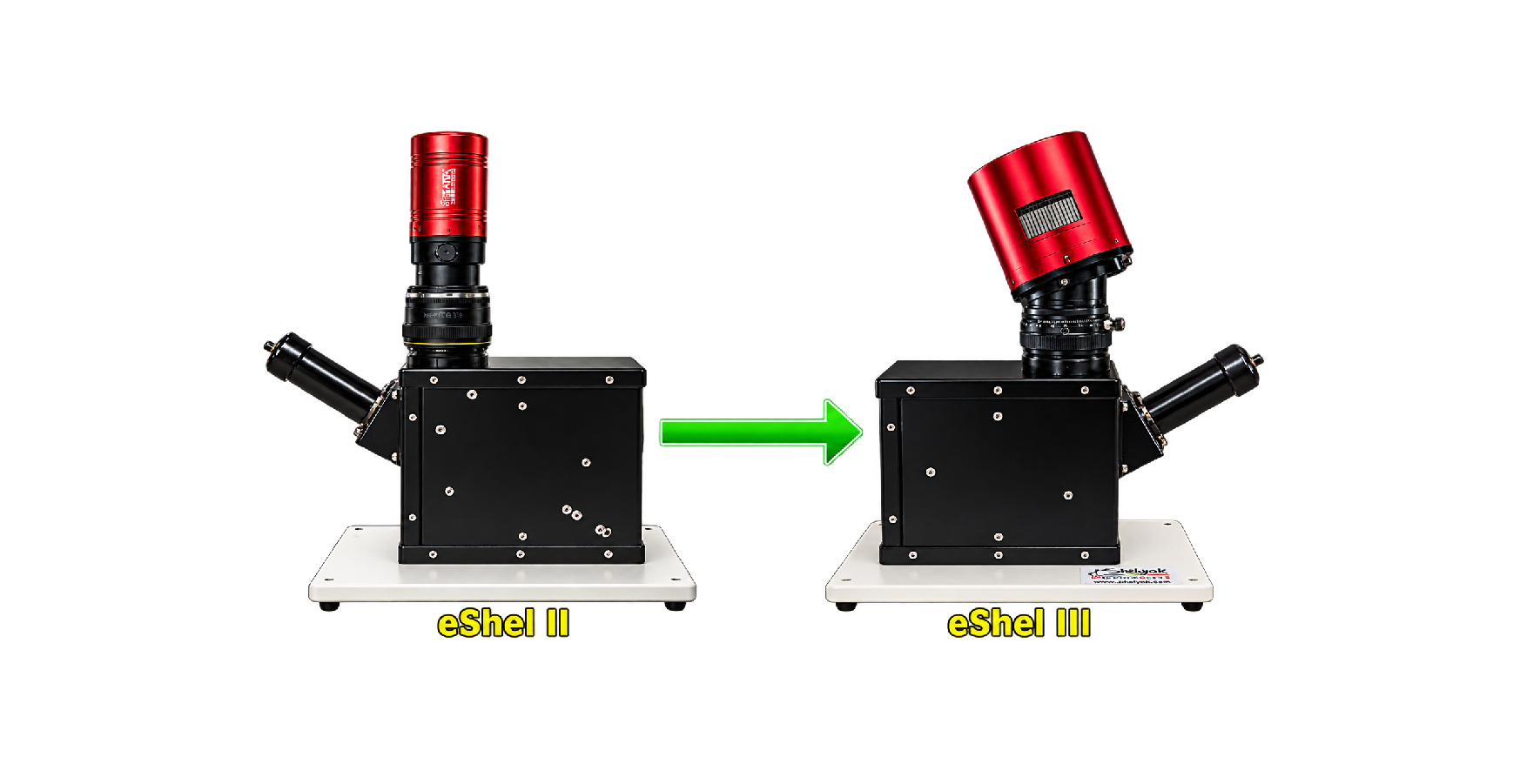

eShel III: an upgrade from the eShel II
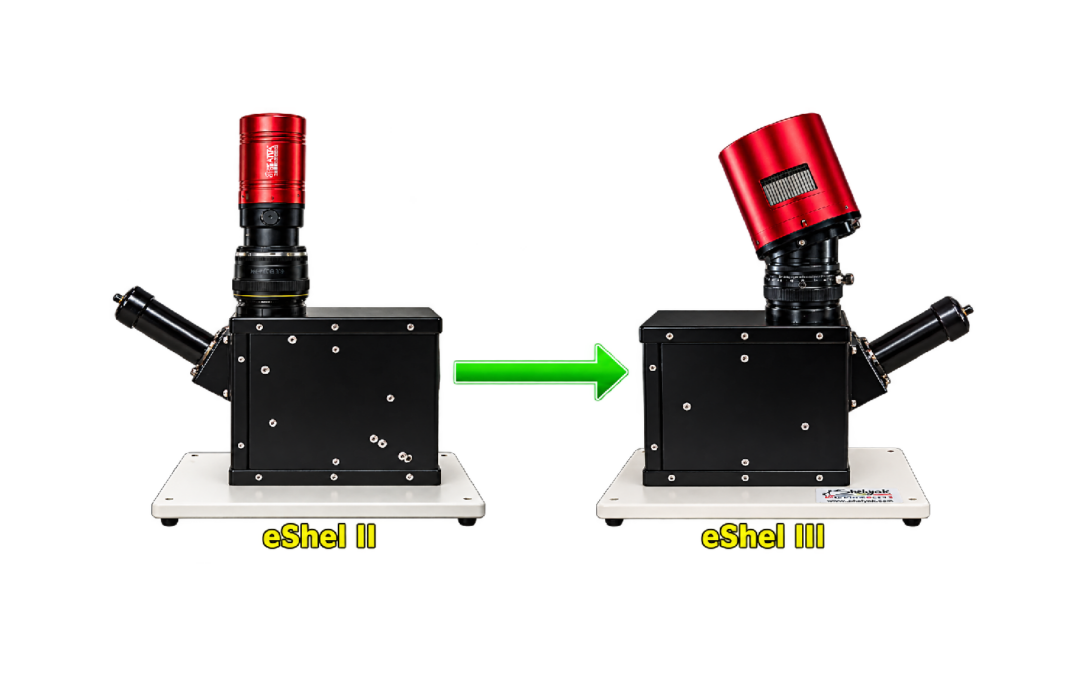
The eShel II featured an 85mm focal length camera lens which is no longer manufactured; an alternative had to be found, and Shelyak Instruments therefore designed its own 122mm focal length Petzval-type lens. This “custom” design has made it possible to optimize the overall quality of the spectra produced:
– More consistent focus across the entire spectrum
– More orders available in the near-UV and, especially, the near-IR
The successor to the eShel II: the eShel III is now available with this new lens, either with manual focus or with motorized focus that can be controlled remotely.
Two types of upgrade are also available to users who already own an eShel II: a manual version and a motorised version with a PrimaLuce Lab focuser. Changing the optics is straightforward, but it is essential to use a sensor that is larger than the ATIK 460ex camera, which is usually used with this spectrograph and which, incidentally, is no longer available. Therefore, we recommend using a SONY IMX 571 sensor, specifically the ASI 2600 MM Pro, which is directly compatible with the eShel III.
Superior Performance
The first advantage that becomes apparent when comparing a raw spectrum from the eShel II with that of the eShel III is a spectrum that is much better focused at the extreme orders of the spectrum and, generally speaking, a more uniform spectrum from one order to the next, and therefore a more uniform resolution as well.
We then find that we can process far more orders using this new approach:
• With the eShel II, it was possible to cover the range from order 31 to 58, inclusive. The raw spectrum shown here illustrates the spectral range obtained using an ATIK 460ex camera and an 85mm lens.
• With the eShel III, the range of orders that can be processed using a thorium/argon lamp is from 25 to 60, inclusive. The raw image shown here was captured using an ASI 2600 MM Pro and a Petzval lens with a focal length of 122 mm.
On the right are details on the extreme orders in the near-UV and near-IR for the eShel II and eShel III versions.


Example of a result on Vega
Here is the spectrum of Vega, obtained using the eShel III on a 406-mm-diameter Ritchey-Chrétien telescope.
9 exposures of 120 seconds each taken with an ASI 2600 MM Pro (gain 101, cooled to -10°C) using 2×2 binning, processed with ISIS software by modifying the line.lst file to include lines in the near-UV and near-IR. (The original file did not go beyond 4,000 Å and 7,500 Å.)
The spectral range is from approximately 3730 Å to 9100 Å (orders 60 through 25, inclusive)

The high resolution of certain spectra for the Balmer series up to H13 and the Paschen series in the near-infrared allows us to observe the last lines in these series (Pa 13, among others).


The spectrum of the star Be 48 Lib
The spectrum was obtained using the same configuration as for Vega on this Be star of magnitude V=4.87, with 6 exposures of 600 seconds each.
On the right, the spliced spectrum of orders #25 through #60; below are the graphs for orders #60 and #34 (H Alpha).


Conclusion
The eShel III version significantly improves on the eShel II version by producing more homogeneous spectra from one order to the next and extending the spectral range covered.
The manual version offers the same focusing mechanism as the eShel II (by turning the focus ring); it is more precise than that of the original 85mm lens, and you can also lock the ring in place once you have found the correct setting (which was not possible with the previous model).
The motorised version will be ideal for use in remote-controlled set-ups to adjust the precise focus of the eShel III. The focuser can be controlled in the same way as a conventional focuser via an ASCOM or INDI driver supplied with the focuser.
For those who already own an eShel II and would like to upgrade their spectrograph to this new version, they can purchase either of the two upgrade options (manual or motorized). The upgrade instructions explain how to remove the old lens and easily install the new one.


Articles, workshops, tutorials...
To not miss any news about astronomical spectroscopy:
Subscribe to our newsletter
Articles, workshops, tutorials...
To not miss any news about astronomical spectroscopy:
Subscribe to our newsletter